Watch, Evaluate and Control Risk
In your AI in production
Watch, Evaluate, and Control Risk
in your AI in production.
Watch, Evaluate,a
and Control Risk
in your AI in production.
Your AI shouldn’t be a mystery. We make it observable.
Compare features across all plans
Compare features across all plans
Trace
Decision
Risk
Playground
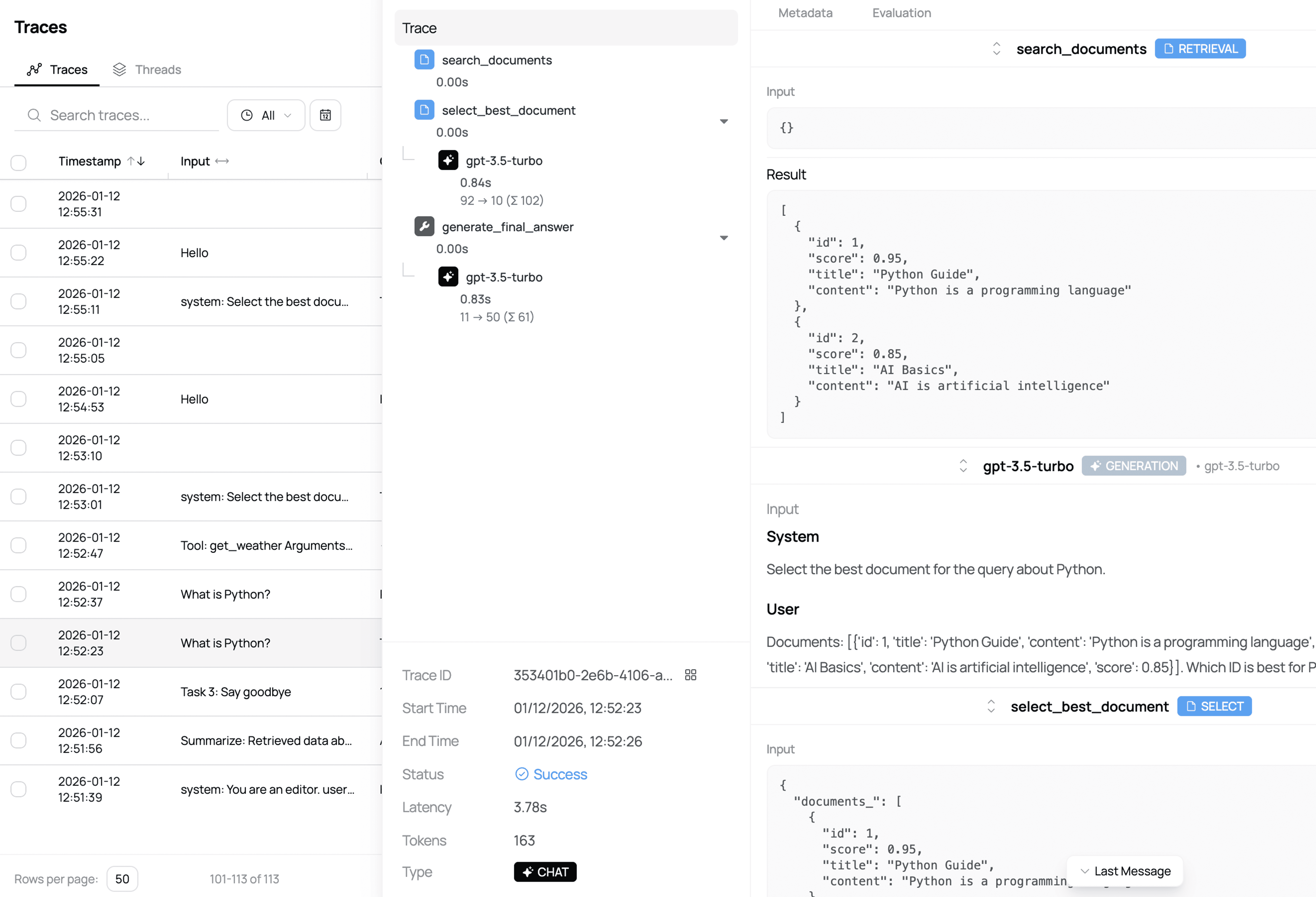
Trace
Decision
Risk
Playground
Trust By





The Problem
The Problem
The Problem
01
Logs keep growing, but teams don’t know what to look at first
In AI operations, operational logs, decision logs, tool calls, and context traces accumulate endlessly. But no team can review everything—and there is no clear way to identify which logs point to risky decisions. As a result, teams often react to whatever error happens to stand out, rather than focusing on what truly matters.
01
Logs keep growing, but teams don’t know what to look at first
In AI operations, operational logs, decision logs, tool calls, and context traces accumulate endlessly. But no team can review everything—and there is no clear way to identify which logs point to risky decisions. As a result, teams often react to whatever error happens to stand out, rather than focusing on what truly matters.
01
Logs keep growing, but teams don’t know what to look at first
In AI operations, operational logs, decision logs, tool calls, and context traces accumulate endlessly. But no team can review everything—and there is no clear way to identify which logs point to risky decisions. As a result, teams often react to whatever error happens to stand out, rather than focusing on what truly matters.
02
Evaluated decisions don’t translate into operational improvement
Some decisions are evaluated, but those evaluations usually stop at reports. It’s unclear which parts of the context—such as RAG, prompts, policies, or tool usage—should be adjusted, or what should change in the next run. In other words, evaluation exists, but learning does not.
02
Evaluated decisions don’t translate into operational improvement
Some decisions are evaluated, but those evaluations usually stop at reports. It’s unclear which parts of the context—such as RAG, prompts, policies, or tool usage—should be adjusted, or what should change in the next run. In other words, evaluation exists, but learning does not.
02
Evaluated decisions don’t translate into operational improvement
Some decisions are evaluated, but those evaluations usually stop at reports. It’s unclear which parts of the context—such as RAG, prompts, policies, or tool usage—should be adjusted, or what should change in the next run. In other words, evaluation exists, but learning does not.
03
Agents grow more complex, but failures become harder to explain
As agents rely on more context, policies, tools, and routing logic, their behavior becomes increasingly complex. When something goes wrong, all that remains is the fact that “the output was wrong.” Was retrieval the issue? Tool selection? Overly strict policies? Or the decision itself? Teams can no longer tell which stage introduced the risk.
03
Agents grow more complex, but failures become harder to explain
As agents rely on more context, policies, tools, and routing logic, their behavior becomes increasingly complex. When something goes wrong, all that remains is the fact that “the output was wrong.” Was retrieval the issue? Tool selection? Overly strict policies? Or the decision itself? Teams can no longer tell which stage introduced the risk.
03
Agents grow more complex, but failures become harder to explain
As agents rely on more context, policies, tools, and routing logic, their behavior becomes increasingly complex. When something goes wrong, all that remains is the fact that “the output was wrong.” Was retrieval the issue? Tool selection? Overly strict policies? Or the decision itself? Teams can no longer tell which stage introduced the risk.
The Solution
We turn operational and decision logs into domain-specific risk signals—and use them to drive evaluation, learning, and prioritization, so production AI improves over time.
The Solution
We treat the entire decision—from intermediate choices to the final output—as a single unit of risk. By structuring, evaluating, and learning from decisions at this level, we create an AI operations loop that enables clear prioritization and continuous improvement.
The Solution
We turn operational and decision logs into domain-specific risk signals—and use them to drive evaluation, learning, and prioritization, so production AI improves over time.
01
We surface only the decisions that matter
Out of the countless decisions made by AI systems, we automatically surface only those likely to cause problems. Teams no longer need to dig through endless logs and can focus on the decisions that truly matter.
01
We surface only the decisions that matter
Out of the countless decisions made by AI systems, we automatically surface only those likely to cause problems. Teams no longer need to dig through endless logs and can focus on the decisions that truly matter.
01
We surface only the decisions that matter
Out of the countless decisions made by AI systems, we automatically surface only those likely to cause problems. Teams no longer need to dig through endless logs and can focus on the decisions that truly matter.
02
We make it clear why an answer was produced
We don’t just show whether an answer was right or wrong. We clearly reveal which decisions along the way introduced risk and shaped the final output. This allows teams to improve based on root causes, not guesswork.
02
We make it clear why an answer was produced
We don’t just show whether an answer was right or wrong. We clearly reveal which decisions along the way introduced risk and shaped the final output. This allows teams to improve based on root causes, not guesswork.
02
We make it clear why an answer was produced
We don’t just show whether an answer was right or wrong. We clearly reveal which decisions along the way introduced risk and shaped the final output. This allows teams to improve based on root causes, not guesswork.
03
We automatically reduce repeated issues
We learn from decisions where the same risks occur repeatedly and automatically apply controls to prevent those issues from recurring. As a result, AI systems become more stable over time, even with less manual intervention after deployment.
03
We automatically reduce repeated issues
We learn from decisions where the same risks occur repeatedly and automatically apply controls to prevent those issues from recurring. As a result, AI systems become more stable over time, even with less manual intervention after deployment.
03
We automatically reduce repeated issues
We learn from decisions where the same risks occur repeatedly and automatically apply controls to prevent those issues from recurring. As a result, AI systems become more stable over time, even with less manual intervention after deployment.
Tracing & Decision
Monitoring
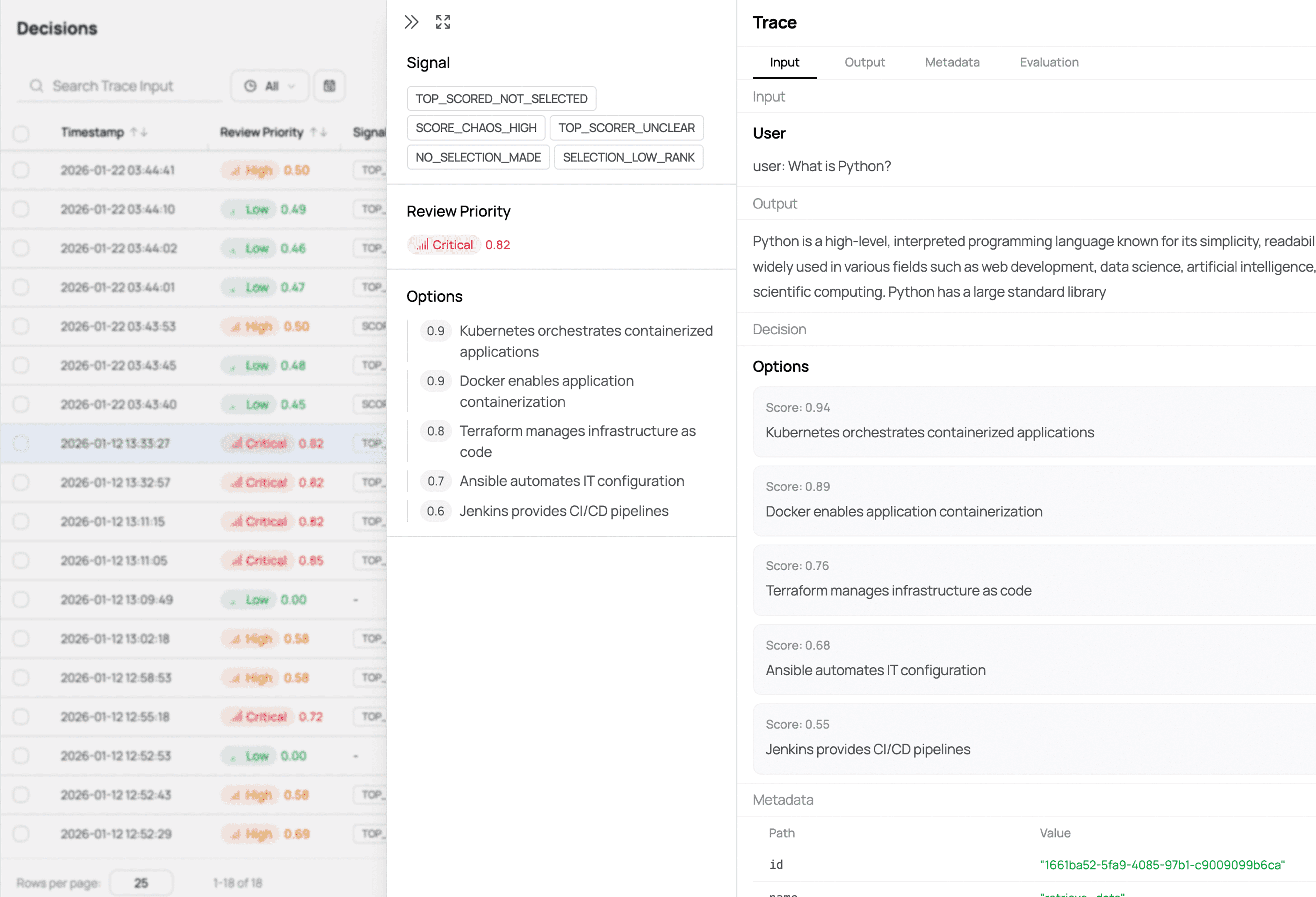
Effortlessly track AI behavior to see every decision as it happens.
Tracing
Decision
Tracing & Decision
Monitoring
Effortlessly track AI behavior to see every decision as it happens.
Tracing
Decision
Tracing & Decision
Monitoring
Effortlessly track AI behavior to see every decision as it happens.
Tracing
Decision
Risk
Risk-first AI evaluation
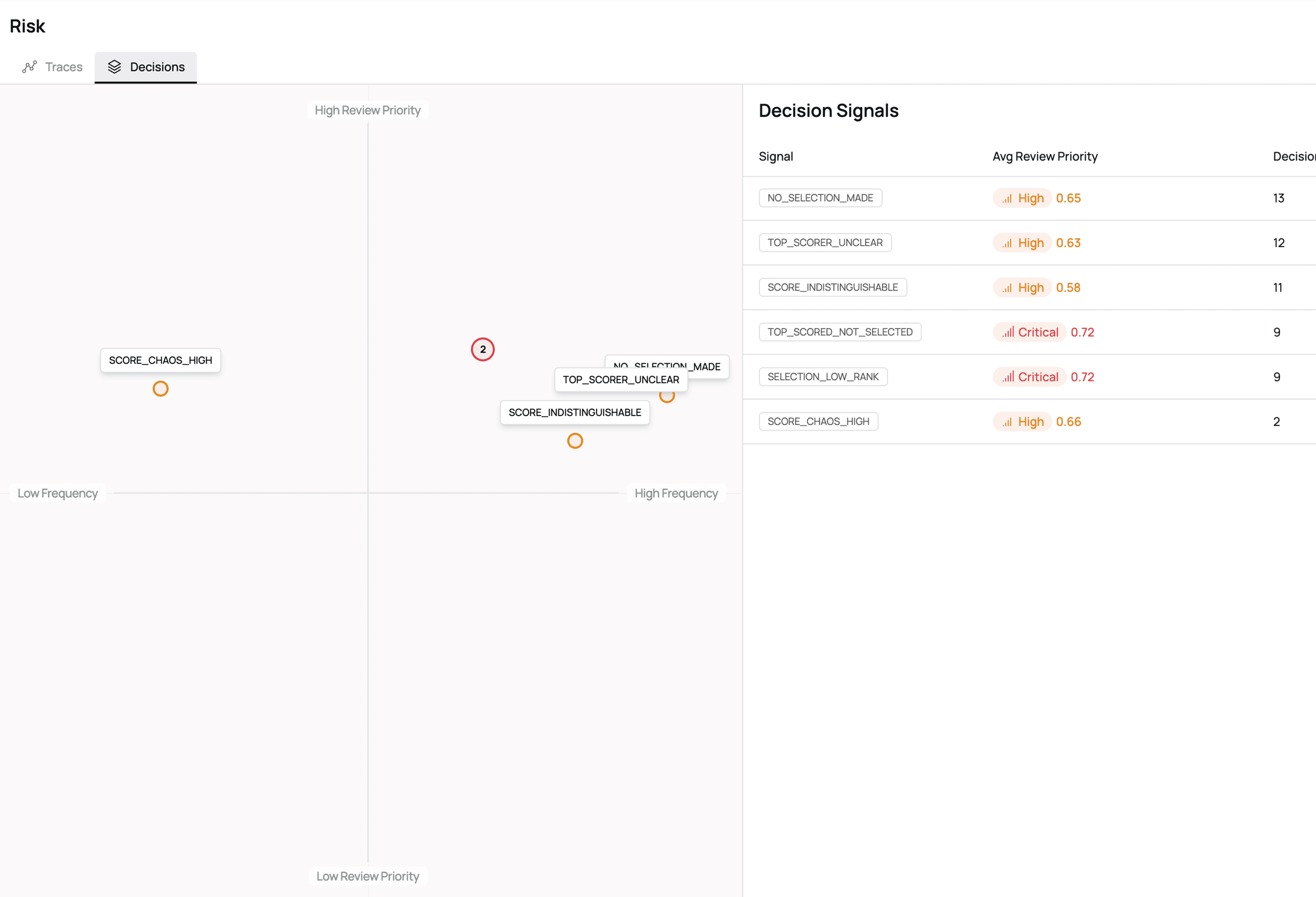
Not every decision deserves review. Risk scoring highlights where human evaluation delivers the highest return—reducing noise, cost, and blind spots
Risk
Risk-first AI evaluation
Not every decision deserves review. Risk scoring highlights where human evaluation delivers the highest return—reducing noise, cost, and blind spots
Risk
Risk-first AI evaluation
Not every decision deserves review. Risk scoring highlights where human evaluation delivers the highest return—reducing noise, cost, and blind spots
Human-Evaluation
Judgment you can trust
Assess trace outputs and decisions together to identify where errors, uncertainty, or risk were introduced — before they compound into failures.
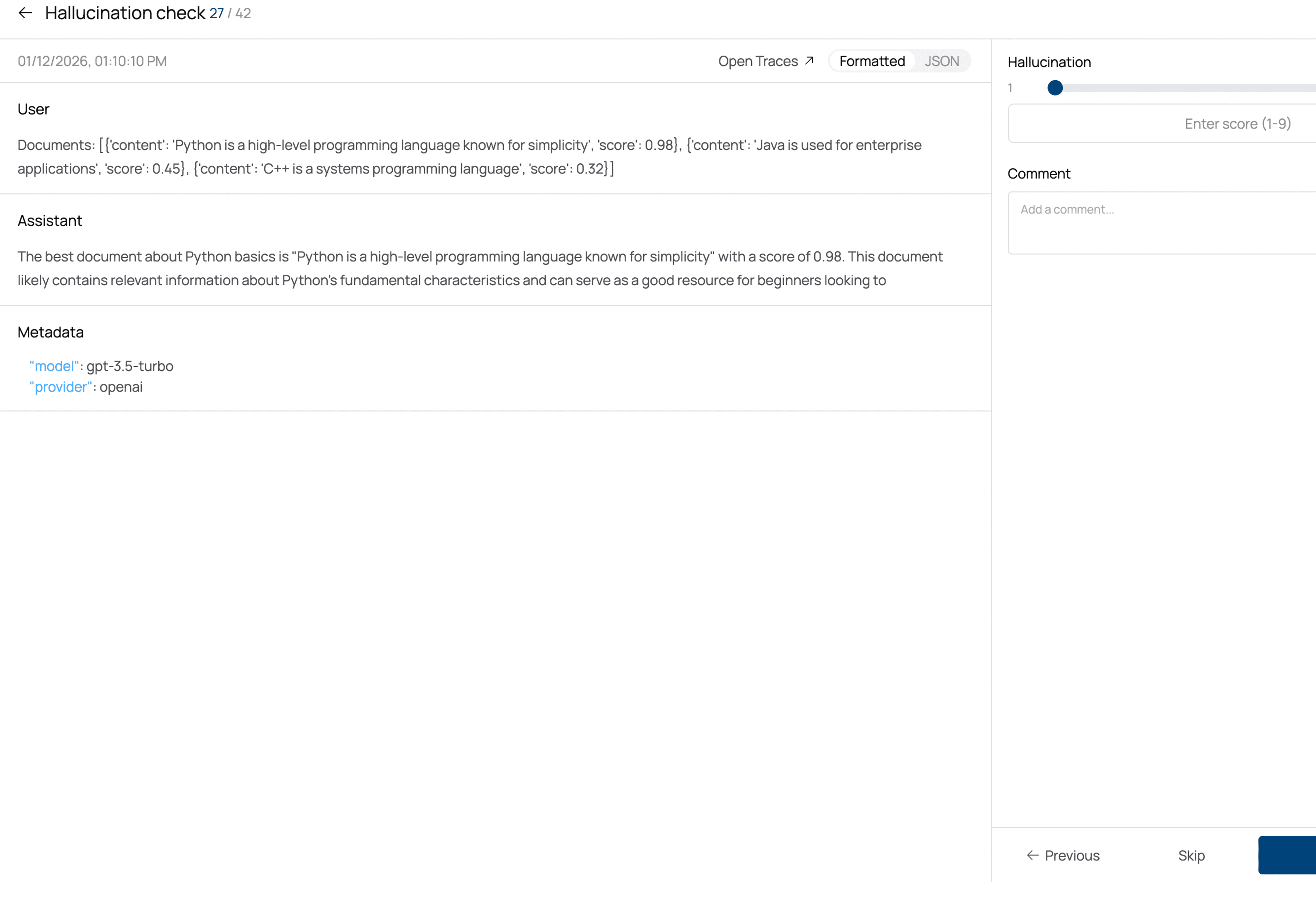
Human-Evaluation
Judgment you can trust
Assess trace outputs and decisions together to identify where errors, uncertainty, or risk were introduced — before they compound into failures.
Human-Evaluation
Judgment you can trust
Assess trace outputs and decisions together to identify where errors, uncertainty, or risk were introduced — before they compound into failures.
Beta
Continuous context improvement
Insights from trace and decision evaluation feed back into prompts, retrieval, tools, and policies—so errors are corrected at their source, not repeated downstream.
Beta
Continuous context improvement
Insights from trace and decision evaluation feed back into prompts, retrieval, tools, and policies—so errors are corrected at their source, not repeated downstream.
Beta
Continuous context improvement
Insights from trace and decision evaluation feed back into prompts, retrieval, tools, and policies—so errors are corrected at their source, not repeated downstream.